Fog pressed low over a tropical river, headlamps cut through the mud, and something massive breathed just beyond the beam.
What began like the opening shot of a thriller ended as a meticulously documented milestone for herpetology: during a planned night survey in an isolated lowland forest, a team of field biologists came face to face with a snake so large that long‑dismissed campfire tales suddenly sounded a lot less exaggerated. This time, though, the encounter came with GPS coordinates, calibrated tape measures and data sheets, not shaky memories and bravado.
A legendary night turned into a line on a data sheet
The team was led by field herpetologist Carla Mendes, who first remembers the smell: river mud, rotting leaves, and a heavy animal musk that clung in the throat. Her group had been walking transects for seven hours through a rarely visited floodplain forest, following coordinates set months earlier as part of a national biodiversity monitoring programme.
On paper, the work sounded almost administrative: walk fixed night lines, record every snake, frog and lizard, measure them, photograph them, release them. On the ground, it meant sweat, leeches on ankles, fogged lenses and notebooks turning to pulp. The giant snake appeared right at the edge of their survey grid, where the forest floor dropped towards a narrow, blackwater stream.
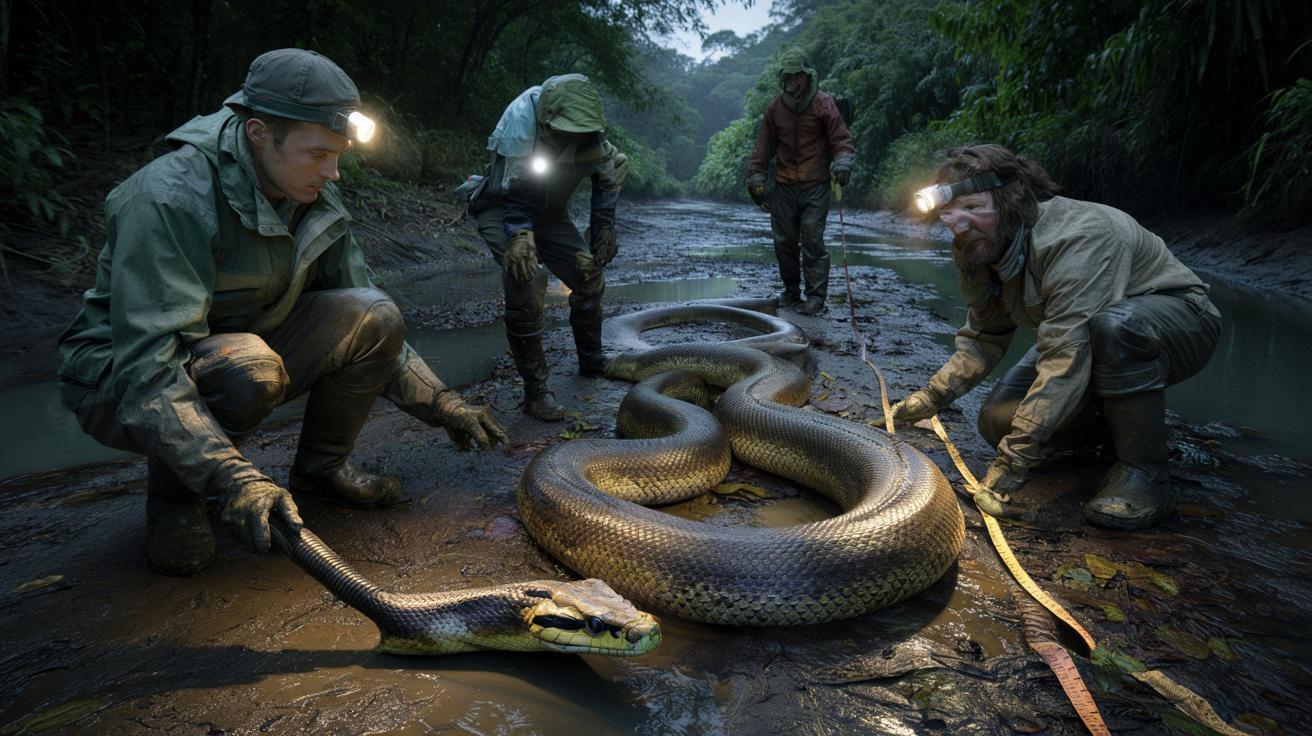
In the pale cone of their headlamps, scales flashed dirty olive and dull gold, smeared with silt. The body looked, at first glance, like a fallen log in an eroded riverbank. Then the “log” exhaled. Slow, wet, and undeniably alive. One biologist whispered, “no way,” while another began counting vertebral scales by habit, hands shaking.
Tales of monstrous snakes travel along almost every major tropical river: hunters speak of “living trunks” blocking channels, fishers swear they have seen coils thicker than a man’s chest. Once someone asks for a clear photo or a measured length, the story usually dissolves. Mendes’ team was different. They were operating under a strict, pre-approved protocol with assigned roles and cross-checks.
For once, a forest legend unfolded inside a framework of GPS points, data sheets and a metric tape glinting in headlamp light.
The team halted the transect, marked the position precisely and activated their capture and restraint procedure. The huge constrictor lay half-submerged, apparently indifferent to the growing cluster of humans. Only when the tape was run from snout to tail tip, under three overlapping beams, did the reality sink in: this was a new world record for a wild individual of that species, measured under scientific conditions. No blurry social media post, no “a friend told me”, just a number repeated and checked that can withstand scrutiny from anyone who wants to verify it.
Why measuring a giant snake almost never happens
Snakes capable of reaching such extreme sizes usually sit at the very top of their food web. They are ambush predators that prefer places where humans rarely set foot: flooded forests, tangles of roots, deep pools where one step can sink a person to the thigh. Perfect habitat for being seen once, remembered forever, and never actually measured.
Most encounters with huge snakes unfold in chaos. It is dark, the ground is unstable, and fear takes over. People run, throw things, or just try to back away. No one calmly lays out a tape along the spine, straightens the body, checks the tail position and notes the time and air temperature.
➡️ “I thought it was just tiredness”: the daily habit that was quietly draining my energy
➡️ Polar bears in Norway’s Arctic are getting fatter and healthier despite the climate crisis
A controlled survey changes the rules. By design, it turns surprise into data. The risk and fear do not vanish, but the situation is framed: there are assigned roles, ready tools and clear safety limits. That structure is what made the difference between “no one will ever believe this” and a measurement that will sit in a peer‑reviewed paper.
How to measure a “monster” without cheating
Once the initial adrenaline dropped, the team’s first move was deceptively boring: they unfolded the printed protocol sheet. No improvisation, because any claim of “largest ever seen” collapses as soon as someone asks, “how did you measure it?”
Two people stabilised the head and anterior body with long padded hooks, keeping a safe distance. They did not wrestle; they controlled. A third biologist ran a flexible tape along the midline of the back, starting at the very tip of the snout and following the main curves. The length was read out loud at regular intervals.
Every step was photographed in overlapping frames: close-ups of the head, mid‑body scale pattern and tail tip, plus full-length shots with the tape clearly visible. In some images, the forearm of a researcher appears as an extra size reference. The snake, thick with muscle, responded with slow, annoyed movements. Now and then, a powerful contraction reminded everyone who truly owned that riverbank.
The human instinct is to exaggerate; on this night the scientists deliberately rounded down, not up.
- tape placed along the dorsal midline, with the body supported but not stretched
- two people reading the same point to reduce human error
- a second tape used as backup in case humidity warped the first
- final value recorded to the millimetre, never “by eye”
- handling time kept as short as possible, with release at the exact capture site
When word spread through herpetology circles, the first questions came quickly: was the animal fully extended? Who held the tape? Were the tools recently calibrated? Mendes and her colleagues had anticipated each of these points, building a redundant record: paper forms, photos, GPS coordinates and notes on temperature, water level and cloud cover.
What one giant snake says about the forest around it
For most readers, the fascination is sheer size. For people who work in the field, that oversized body is an ecological message. A constrictor that reaches record dimensions signals one basic thing: the habitat still offers enough prey, enough space and enough time for a slow‑growing predator to live a long, uninterrupted life.
The same survey that logged the snake also tracked frog calls along the stream, catalogued small fish diversity in side pools and marked every sign of human presence: shotgun shells, plastic, logging paths. That context will sit beside the snake’s measurements in official reports and assessments of the area’s condition.
| Key factor | What it suggests | Why it matters |
|---|---|---|
| Large apex predator present | Abundant prey and functioning food web | Indirect sign of relatively intact ecosystem |
| Remote, hard-to-reach site | Low immediate human pressure, but attractive for future projects | High priority area for conservation planning |
| Structured monitoring programme | Repeatable data over multiple years | Solid base for political and management decisions |
Questions scientists and readers keep asking
- Is the snake an official record? The team describes it as a record for a wild individual of that species measured under scientific standards. That means the methods meet accepted criteria, with documentation that can be reviewed and challenged.
- How do you avoid overestimating length? Trained teams never rely on visual guesses. They follow the spinal midline, repeat measurements and choose conservative figures. Even a small arch in the body, if ignored, can add several centimetres.
- Was the animal sedated? In this case, no. The researchers used distance tools and enough people to steer the body safely, keeping handling brief to limit stress and health risks.
- Could there be larger snakes out there? Realistically, yes. Any measured record is just the visible tip of a population. Many giants die of age, injury or hunting without ever meeting a tape or camera.
- Does this change anything for the forest? A charismatic animal of this size often becomes a flagship. It can influence impact assessments, motivate protected‑area proposals or help channel funding toward long‑term monitoring.
Risks, limits and what comes next for teams studying giants
Behind every dramatic photo of a record snake lies slow, methodical work and calculated risk. Night surveys in flooded terrain bring plenty of hazards: bites and constrictions, infections from cuts in muddy water, falls, or encounters with other large animals. Well‑run teams train hard before heading out, running capture drills, first‑aid simulations and radio communication tests.
There is also a softer but real danger: turning wild animals into targets for thrill‑seekers. Once a record hits the headlines, untrained visitors may try to track down “the monster” for selfies, trophies or illegal trade. Researchers try to blunt that effect by keeping location details vague and framing the story around science and habitat, not just shock value.
What this kind of data means for everyday life
For someone reading on a sofa thousands of kilometres from any tropical river, this story still offers useful lessons. One concerns how we judge wildlife claims online. Knowing that robust records rest on protocols, repeat measurements and strong evidence helps separate “I saw something huge” from a measurement that can sit in a government report or conservation plan.
Another angle touches on personal choices. Donations to serious field projects, nature trips run by qualified guides and a refusal to support attractions that keep snakes and other wildlife for staged photos all feed back into these remote ecosystems. A record‑size constrictor is more than a curiosity: it is a sign that, somewhere, food chains still function well enough to raise a slow, vulnerable predator to full size. For people far from the forest, the quiet question is what daily decisions help keep those distant chains intact, and which habits, from what we buy to where we travel, slowly weaken them.