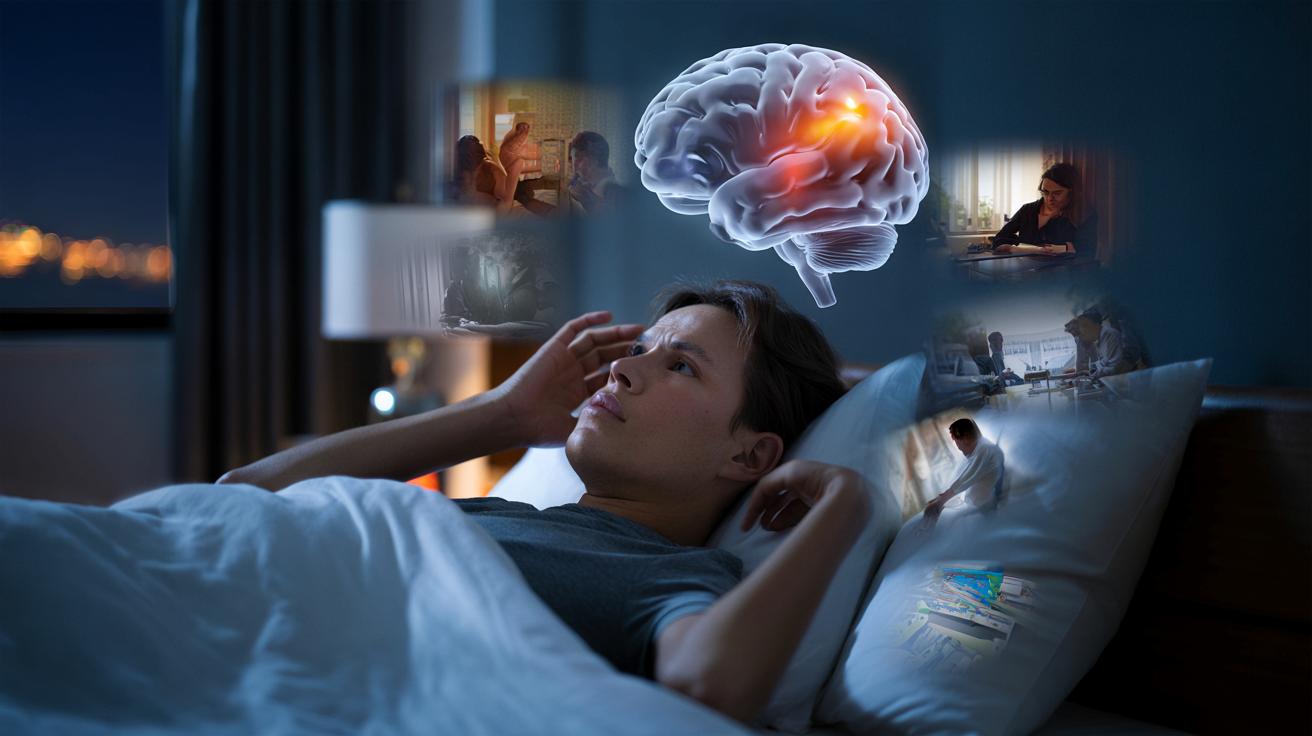
Most people don’t realise their bedroom turns into an emotional office after dark, where the brain quietly reopens unfinished files.
The lights are out, the phone is on charge, and your body is begging for sleep. Yet your mind starts replaying old arguments, awkward moments and half-made decisions as if it’s prime time. Psychologists say this late-night overthinking is less about drama and more about how the brain handles emotions it never got to finish processing during the day.
Why the mind gets louder when the lights go off
During the day, most brains run on urgency. You answer emails, commute, deal with colleagues, family, notifications and noise. That constant stream forces the brain to focus on tasks and deadlines rather than feelings.
Once night comes, the external world quietens. The emails stop. The messages slow down. Your calendar finally leaves you alone. That’s precisely when your inner life clocks in for a night shift.
Night-time overthinking often reflects “unfinished emotional processing” rather than personal weakness or being “too sensitive”.
Psychologists use that phrase to describe the emotional reactions we push aside instead of addressing: the comment that stung, the decision we’re avoiding, the resentment we swallowed. During the day, distraction is easy. At night, there’s nowhere for those reactions to hide.
Research backs this up. A 2020 study in the journal Sleep found that people who ruminate a lot are more likely to have broken, restless nights. Their lives weren’t necessarily more chaotic than anyone else’s. Their brains were simply looping old material, particularly unresolved experiences, instead of letting go.
Neuroscience offers a second piece of the puzzle. As you move towards sleep, the prefrontal cortex – the part of the brain tied to logic, planning and perspective – winds down. Emotional centres, like the amygdala, stay relatively active. That leaves plenty of feeling, but fewer internal “brakes” or filters.
The result:
- Worries feel bigger than they did at lunchtime.
- Minor embarrassments suddenly look catastrophic.
- Old memories show up with fresh intensity.
Your brain is not deliberately torturing you. It’s trying to make sense of loose emotional threads without its full reasoning team on duty. That’s why thoughts repeat, twist and exaggerate in the dark.
➡️ Polar bears in Norway’s Arctic are getting fatter and healthier despite the climate crisis
➡️ Field biologists confirm record-breaking snake during controlled survey in remote forest
➡️ “I thought it was just tiredness”: the daily habit that was quietly draining my energy
Unresolved emotions: what your brain is really doing at 2 a.m.
Emotional memories are not simple files you can drag to the trash. They are patterns spread across the brain and body: sensations in the chest, tightness in the jaw, flashes of images, familiar storylines. A quick comment from a colleague can echo an old fear of rejection. A bank notification might tap into years of money anxiety.
Night overthinking is often the brain’s attempt to “finish a conversation” that was muted earlier in the day.
If you repeatedly tell yourself, “I don’t have time for this,” whenever sadness, anger or shame appears, those emotions rarely disappear. They wait. When the distractions fade, they push back in – hard.
Psychologists say night spirals frequently cluster around a few themes:
- Fear of failure or being exposed as “not good enough”.
- Fear of abandonment or rejection in relationships.
- Regret over past choices and “what if” scenarios.
- Worry about future security – health, money, work.
The specific memory might change from night to night. One evening it’s a text you regret. Another, a job you left. Underneath, the emotional wound is often similar. The brain is scanning for patterns and trying, in its own clumsy way, to protect you from repeating old pain.
How to interrupt the spiral without declaring war on your brain
Many people respond to 2 a.m. thoughts by doing exactly what makes them worse: arguing with them. You plead, bargain, analyse and mentally draft emails at 3:12 a.m. That heavy thinking asks a half-asleep brain to solve complex problems while flooded with emotion. No wonder it goes in circles.
Externalising: getting the mess out of your head
One of the simplest techniques backed by therapists is externalising. Instead of mentally wrestling with racing thoughts, you give them a physical landing place.
That can look like:
- Jotting down everything you’re worried about on paper.
- Starting each line with “I’m scared that…” or “I’m angry about…”.
- Recording a quick, unedited voice note on your phone.
Externalising tells the nervous system: “These concerns are noted and can be handled later; they don’t need to dominate the night.”
People often report that once a fear is written down, the emotional intensity drops. The issue hasn’t magically gone away. The brain simply stops feeling solely responsible for carrying it in memory overnight.
Calming the body so the thoughts lose fuel
Another key point: overthinking at night sits on top of a revved-up nervous system. The more alert your body feels, the stickier the thoughts become.
Simple grounding strategies can help:
- Slow, counted breathing, such as inhaling for four seconds and exhaling for six.
- A body scan, mentally moving from toes to head and noticing sensations without judgement.
- Soft repetition of a phrase like, “Right now, I am lying in my bed and I am safe.”
These tactics don’t erase the worries. They cool the physiological arousal underneath them, which makes the mental stories less convincing. Your aim isn’t to banish every thought. It’s to send your brain a clear signal that it doesn’t need to stay on high alert.
Changing the pattern before bedtime
Psychologists are increasingly pointing to what happens before lights-out as a crucial factor. If your only quiet emotional moment arrives when your head hits the pillow, it’s no surprise that your mind grabs it.
Short emotional “check-outs” that take ten minutes
A growing number of therapists recommend a brief “emotional check-out” each evening, separate from the bedtime routine. It can be five to ten minutes at the kitchen table or on the sofa, not under the duvet.
Three simple questions can structure it:
- What did I feel today?
- Where did I feel it in my body?
- What did I avoid saying or admitting?
Giving emotions some daylight attention reduces the pressure for them to burst through in the early hours.
The aim is not poetic journalling or a perfect therapy worksheet. Scrappy bullet points are enough. The brain starts learning that emotional material is allowed airtime while you’re awake, so it doesn’t have to knock so hard at 2 a.m.
When night overthinking is a warning signal
Not every bout of late-night rumination signals a crisis. Life is stressful, and occasionally lying awake worried before a big exam or important meeting is human. Still, recurring patterns can be informative.
If the same themes keep returning – a job that leaves you drained, a relationship that feels unsafe, a lifestyle that doesn’t match your values – the night-time noise can function as an internal protest. The brain keeps highlighting the same scenes because, so far, you haven’t acted on them.
That doesn’t mean quitting your job by Friday or ending a relationship overnight. It means treating the thoughts as rough drafts of deeper concerns rather than pure “irrational anxiety”. In daylight, with more rational capacity available, you can ask: “What was last night really about?” Then you can decide on small, realistic next steps.
Practical toolbox for restless nights
Many experts suggest building a tiny, personalised kit for those nights when the mind refuses to switch off. It doesn’t need to be elaborate or expensive.
| Tool | How it helps | Example use at 2 a.m. |
|---|---|---|
| Grounding exercise | Brings attention back to the present moment and physical sensations | Noticing 5 things you can see, 4 you can touch, 3 you can hear |
| Expression outlet | Gives emotions a container outside your head | Writing one page of unedited thoughts in a notebook |
| Self-soothing habit | Signals safety and comfort to the nervous system | Listening to a calm podcast or stretching gently in the dark |
| Boundary phrase | Sets a mental appointment with your worries for the next day | Telling yourself, “I will think about this at 10 a.m. tomorrow” |
| Social follow-up | Prevents you from carrying ongoing worries alone | Planning to mention the issue to a friend or therapist |
Key terms and real-life scenarios
Two phrases often used in this field are worth unpacking.
Rumination describes the mental habit of chewing over the same worries again and again without moving towards action or acceptance. It feels active – you’re thinking hard – but usually leads nowhere. People stuck in rumination often believe that if they think long enough, they’ll find the perfect solution. In reality, it usually inflates fear and steals sleep.
Hyperarousal refers to a state where the body remains on alert, as if a threat is nearby. Heart rate is slightly elevated, muscles stay tense, breathing is shallow. In that state, the brain scans for danger. Ordinary problems can look terrifying, especially late at night.
Imagine two different nights. On Monday, you’ve had an argument with a partner and never really addressed it. You scroll social media until midnight, then collapse into bed. At 3 a.m. you wake, heart racing, replaying every line of the conversation and imagining new ones. That’s unfinished emotional processing meeting hyperarousal.
On Wednesday, you spend ten minutes after dinner acknowledging you felt hurt and confused. You write down one thing you’d like to say next time. Before bed, you do five minutes of slow breathing. You might still wake briefly, but the thoughts pass more quickly. The brain has a note on file: “This is being dealt with.”
For some people, especially those living with anxiety disorders, depression or past trauma, night overthinking can become overwhelming and constant. In those cases, professional support can make a real difference. Therapy offers a space where those “files” can be opened gradually and safely, instead of spilling out in the dark when you’re alone and exhausted.