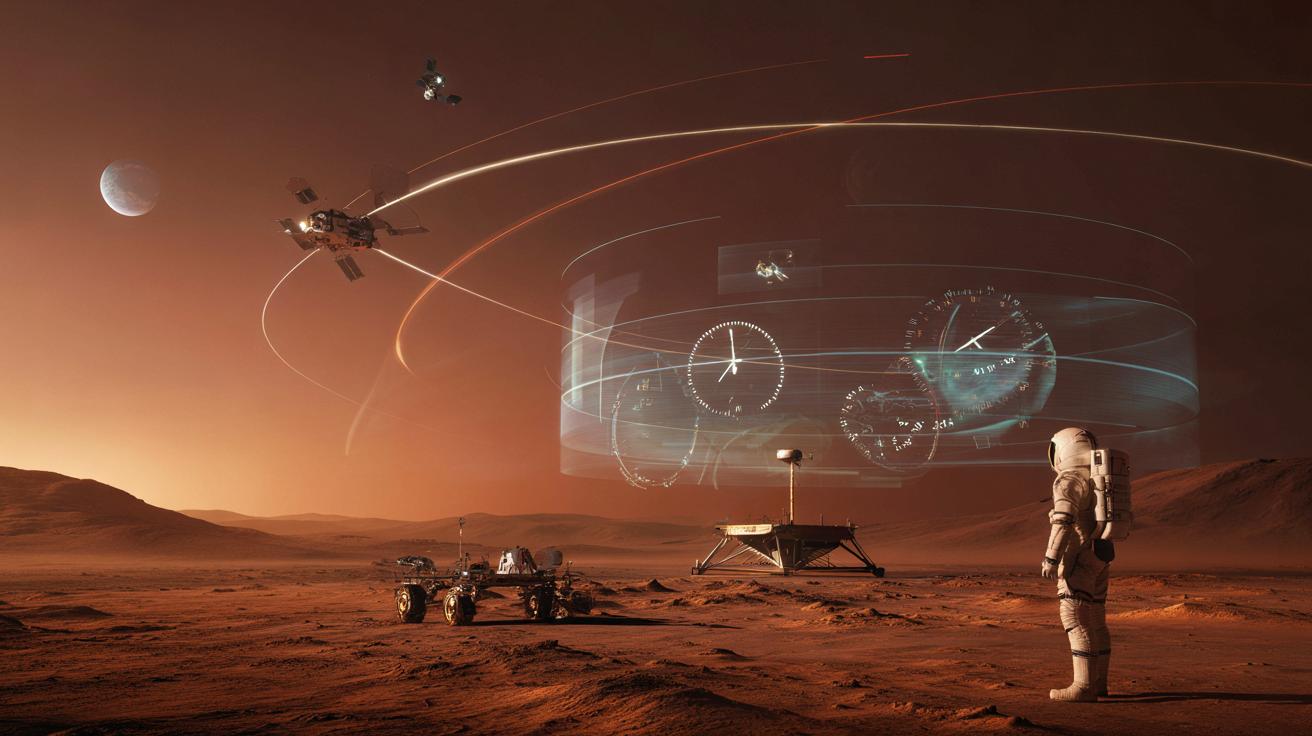
<strong>Control rooms on two continents watched their clocks disagree with Mars by a breath of a second, and that tiny mismatch changed everything.
What looked like a trivial delay in a landing signal has turned into a wake-up call for space agencies. Mars, it turns out, does not fully share our definition of a second. The planet’s weaker gravity, different orbit and motion mean that time itself ticks at a slightly different rate, exactly as Albert Einstein’s general relativity anticipated more than a century ago.
Einstein’s old suspicion meets the red planet
Einstein never saw Mars, but his equations got there long before any rover wheel touched the dust. In 1915, with general relativity, he argued that gravity is not simply a force pulling things down. Instead, mass bends space and time, changing how clocks run.
For decades this stayed on blackboards. Elegant, clever, but distant from everyday engineering. Then came ultra-precise atomic clocks, deep-space antennas and interplanetary probes able to track time differences smaller than a millionth of a second. That is when the numbers stopped lining up perfectly.
Engineers rechecked distances, software and instruments. The remaining explanation was blunt: Mars lives in a slightly different space-time rhythm from Earth.
Radio signals exchanged between Mars orbiters, landers and Earth show that a “perfect” second on Mars does not exactly match a “perfect” second on Earth. The gap is microscopic, but when you are trying to land a multibillion-dollar spacecraft onto a rocky ellipse the size of a small town, microscopic starts to matter.
Why Martian time slips away from Earth time
The offset comes from a mix of very real physics:
- Mars has lower mass than Earth, giving it weaker surface gravity.
- It orbits farther from the Sun, sitting in a different part of the solar system’s gravitational “well”.
- It spins and travels around the Sun with different speeds than our planet.
Relativity adds two key rules:
- the stronger the gravity, the slower time flows;
- the higher the relative speed, the more time dilates.
Because Earth and Mars sit in different combinations of gravity and motion, their clocks drift apart when compared with extraordinary precision. We are not talking science-fiction scenes where someone ages at half-speed. We are talking microseconds turning into milliseconds over months and years.
For normal life, that is irrelevant. For navigation software trying to fire descent engines at exactly the right instant, this creeping mismatch can be the difference between a gentle landing and a shattered probe.
➡️ Psychology confirms it: real inner peace comes when you stop expecting this from others
➡️ Field biologists confirm record-breaking snake during controlled survey in remote forest
➡️ “I thought it was just tiredness”: the daily habit that was quietly draining my energy
How missions will have to bend to Martian time
So far, space agencies have mostly focused on one practical difference: the Martian day, or “sol”, which lasts about 24 hours and 39 minutes. Mission teams on Earth have already run on Martian shifts, slowly drifting their working hours later each day to match rover operations. Hard on sleep cycles, but manageable with calendars and coffee.
That approach will no longer be enough. The new challenge is not just a longer day. It is a different tempo of time itself, encoded in physics. Future missions will need a dedicated timing infrastructure built for Mars from the ground up.
The idea gaining traction is a fully fledged “Martian time system”: a web of ultra-stable clocks on orbiters, landers and future habitats, constantly synchronised and corrected using Einstein’s equations.
Engineers already talk about a “relativistic Mars reference frame” for time. In this framework, every timestamp is adjusted for Martian gravity, its distance from the Sun, and the planet’s motion relative to Earth and other spacecraft. Time becomes another variable to be engineered, not just a number on a display.
Microseconds that make or break a landing
The temptation is to treat all this as a subtlety for theorists. Landing scenarios show why that attitude is risky.
- A lander must fire its descent engines for exactly 18.3 seconds.
- Altimeters and velocity sensors stream data to the onboard computer.
- The guidance software uses its internal clock to time burns and check altitude.
If that clock has drifted due to months in a slightly different gravitational and motion environment, even a tiny timing error can slip in. The burn might end a fraction of a second too early or too late. On a boulder-strewn plain, those few metres can decide whether legs touch down on firm soil or the vehicle slams into a hidden ridge.
For that reason, mission planners are embedding relativistic corrections into all stages of a Mars campaign:
- insertion into Martian orbit;
- coordination between orbiters and descending craft;
- timestamping of scientific data and images;
- future medical monitoring of astronauts’ hearts, brains and sleep patterns.
Towards a “Mars coordinated time”
On the horizon is a concept that could reshape how humanity talks about hours and days on another world: a Mars Coordinated Time, or MCT. It would be Mars’s equivalent of UTC, the time standard used on Earth for everything from aviation to smartphones.
Picture every Mars base, rover and satellite showing the same master time, while hidden algorithms quietly correct for gravity quirks and orbital motion in the background.
In daily life, astronauts might juggle several overlapping clocks:
- a local habitat time, tuned to a comfortable routine and lighting schedule;
- a mission time, tightly linked to MCT for critical operations and communication windows;
- a “home time” for Earth, keeping calls with families and control rooms sane.
Designers now face a human-factors puzzle: how to present multiple times without overwhelming crews. Interfaces will need to make complexity invisible most of the time, flashing warnings only when time offsets start to affect safety or procedures.
What this means for people living and working on Mars
Time management on Mars will not be just a software problem. It will shape psychology and routine.
- Circadian rhythms will be nudged to follow a 24-hour-39-minute day, which matches no natural cycle on Earth.
- Communications with Earth already carry a delay of 4 to 24 minutes, depending on planetary positions, and will include small timing corrections on top of that.
- Every call, video or control signal will be routed through timing systems that compensate for relativistic effects and distance.
Some researchers talk about “temporal literacy”: astronauts will need a basic feel for why two clocks can disagree and what that means for a checklist, a maintenance task or a medical scan. Understanding time will become part of operational training, not just physics lectures.
When birthdays and calendars stop lining up neatly
The non-universality of time has quiet, personal consequences too. A parent on Earth and a child on Mars will celebrate the same birthday according to slightly different calendars. Over a human lifetime the relativistic effect remains tiny, but perception shifts. “What time is it there?” no longer has a simple answer without specifying which clock you mean.
| Aspect | What happens | Impact on missions |
|---|---|---|
| Flow of time | Different gravity and motion slightly alter the effective length of a second | Continuous corrections needed for navigation and landing precision |
| Time systems | Proposal for a shared Mars Coordinated Time standard | Stronger consistency between bases, rovers and Earth-based control |
| Everyday life | Multiple clocks: local, mission and Earth time | Risk of confusion if tools and training are poorly designed |
Key concepts: time dilation and atomic clocks
Two technical phrases sit at the centre of this debate: time dilation and atomic clocks. They sound abstract, but their effects are very concrete.
- Time dilation: when two observers sit in different gravitational fields or move at different speeds, they measure slightly different time intervals for the same event. On Earth, GPS satellites already deal with this. Their onboard clocks tick at a different rate from clocks on the ground, and engineers correct for that every day to keep your satnav position accurate.
- Atomic clocks: these devices measure time by counting the oscillations of specific atoms, like caesium. Their precision is extraordinary; they can detect time differences produced by lifting a clock just a few metres higher in a gravitational field. Putting such clocks around Mars makes the planet’s time distortion measurable instead of theoretical.
Future scenarios: from self-driving rovers to Martian cities
As human activity around Mars scales up, timing issues will multiply. Several plausible scenarios highlight the stakes.
- Networks of autonomous rovers: dozens of vehicles coordinating surveys over hundreds of kilometres. If their clocks drift apart, reconstructing who was where at which second after an accident or anomaly becomes messy.
- Busy Martian orbit: communications satellites, weather monitors, cargo ships, crew vehicles and sample-return missions all sharing the same narrow orbital lanes. Precise rendezvous and collision avoidance depend on timestamps that match to fractions of a millisecond.
- Multiple habitats: scattered settlements using local apparent solar time for daily life, while also anchoring to Mars Coordinated Time for inter-base logistics, flights and shared infrastructure.
Each decision, from launching an automated cargo craft to synchronising medical records between a Mars clinic and an Earth hospital, will run through timing systems that acknowledge time as elastic, not rigid. Engineers will test these systems in simulations, pushing them through failures, delayed signals and clock drift to see where confusion creeps in.
For the generations who settle Mars, relativity will stop being a chapter in a physics textbook and become a background rule of daily organisation: the silent reason an alarm rings when it does, a docking happens on schedule, or a call from home arrives slightly “out of phase”.