Far below the choppy surface of an Indonesian sea, a small team of French divers followed their beams of light into the quiet.
Their mission was simple on paper and brutally complex in reality: reach the twilight edge of a remote reef, hold their nerve at depth, and hope that something extraordinary chose to pass through their narrow cone of vision.
A silent meeting on a shadowed reef
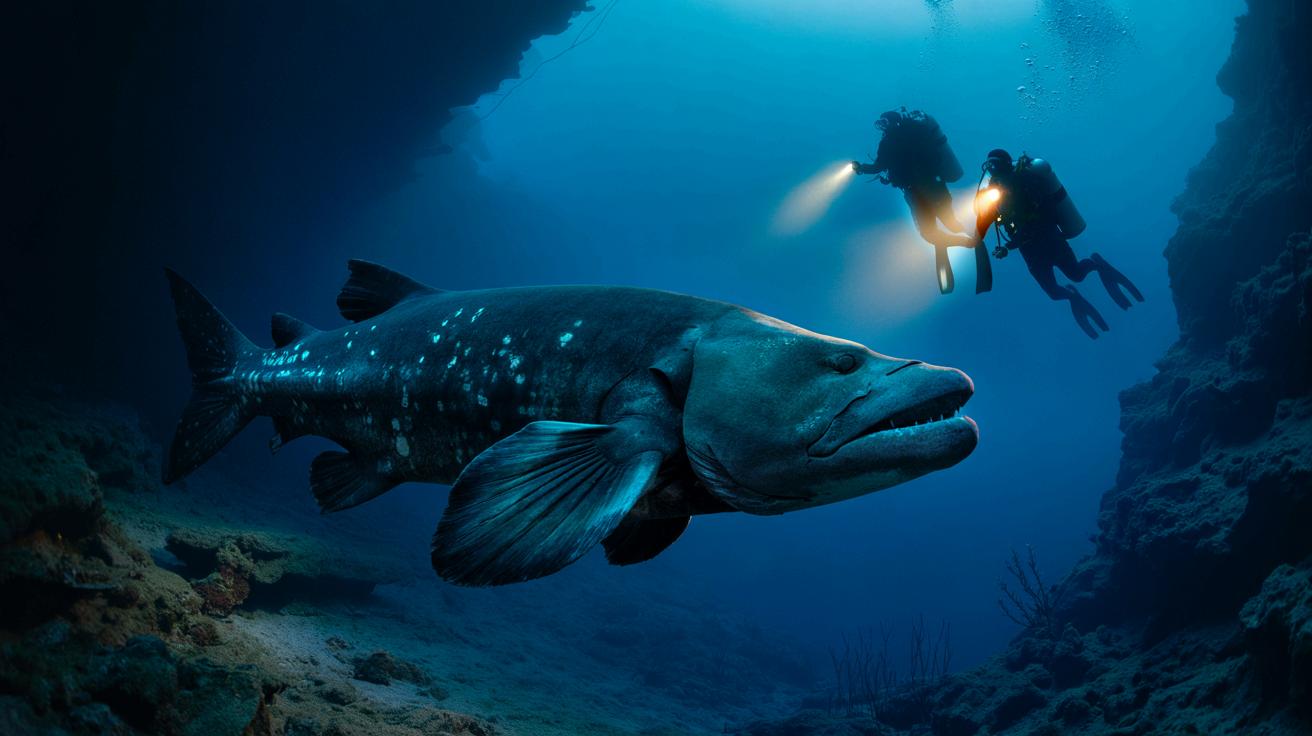
The moment itself lasted only a few minutes. At around 40–50 metres, where daylight fades to cobalt gloom, one diver’s torch caught a shape that did not belong among flickering reef fish. It was big, unmistakably muscular, and moving with an oddly measured rhythm.
Thick, lobed fins beat like slow paddles. Heavy scales shimmered in the light, not delicate like a snapper’s but thick and plate-like, as if designed for a different era. A constellation of white spots ran across the body like a scatter of stars.
In those few suspended minutes, French divers captured the first documented images by their compatriots of a wild coelacanth in Indonesian waters.
The animal hardly reacted to the divers’ presence. It rotated its bulky head, shifted a little deeper, and simply carried on, as if nudging the intruders back toward their depth limits and decompression schedules.
On the surface later, the team’s reactions weren’t polished soundbites. They were bursts of laughter, half-swearing, and broken sentences – the raw relief of people who knew they had just crossed paths with a creature whose family tree reaches back 400 million years.
What makes the coelacanth so special?
The coelacanth has long been scientific shorthand for “we thought that was extinct”. For most of the 20th century, the species existed in textbooks as a fossil line that vanished with the dinosaurs, then staggered academics in 1938 when a trawler off South Africa hauled one up alive.
Since that shock, the animal has occupied a strange niche: both celebrity and recluse. Two known species are recognised today – one off eastern Africa, one in Indonesia – living mostly in deep, steep-walled habitats rarely visited by humans on scuba.
A fish that bends our sense of time
- Coelacanths belong to an ancient group of lobe-finned fishes, relatives of the lineage that eventually gave rise to amphibians, reptiles and mammals.
- They can reach nearly two metres in length and weigh close to 90 kilograms.
- Their skeletons, fins and even their curious “hinged” skull architecture retain traits that echo early vertebrate evolution.
- Despite their archaic outline, genetic studies show they have continued to evolve, just at a slower morphological pace than many modern species.
The phrase “living fossil” sticks because the silhouette feels frozen in deep time, even though evolution never truly stops.
➡️ According to psychology, life really starts to improve when you stop chasing other people’s approval
➡️ Psychology confirms it: real inner peace comes when you stop expecting this from others
Indonesian coelacanths, formally described only in the late 1990s, may be even harder to observe than their African relatives. Sightings often come from deep nets, submersibles or chance captures by local fishers working steep drop-offs.
Months of planning for minutes of footage
This French mission was not a random lucky dip into deep water. It was the end point of patient preparation, dominated less by adrenaline than by spreadsheets, charts and caution.
Stacking the odds in Indonesian waters
The team targeted North Sulawesi, where undersea cliffs plunge from coral shallows into the dim blue. Fisher stories spoke of “large blue fish with white spots” that occasionally appeared in deep nets. That was enough to start drawing lines on charts.
| Preparation step | What the team did | Reason |
|---|---|---|
| Habitat mapping | Studied submarine canyons, walls and caves between 150–300 m | Coelacanths favour high-relief, cool, current-swept slopes |
| Ocean conditions | Cross-referenced temperature, current models and moon phases | Improved chances of animals moving shallower at night |
| Local knowledge | Interviewed fishers, guides and Indonesian researchers | Turned rumours and old photos into specific target areas |
| Dive strategy | Planned dawn and dusk technical dives to 50–60 m | Reached the upper fringe of coelacanth range safely |
The approach was almost monastic: small teams, no scooters, minimal lighting, and slow descents along the rock face. Divers accepted that most of their logbook entries would describe nothing more dramatic than cold hands and blue emptiness.
On the night that paid off, conditions were far from ideal. Wind chopped the surface, the current tugged at depth, and one diver had already signalled to abort. Another saw a promising cave, insisted on checking it briefly, and the plan stretched by a few cautious minutes. That extension was the margin in which the coelacanth slid out from a ledge below them and into history.
Ethics in the twilight zone
As soon as images like these appear online, a familiar pattern starts: social feeds fill with clips, and ambitious divers begin to wonder how to replicate the feat on their next trip. That mindset worries professionals more than any single deep dive.
Diving to 50–60 metres in remote Indonesia is not an “add-on excursion” from a beach resort. It is technical, unforgiving and demanding.
Rules that kept this mission safe
- Limit the spotlight: Torches and strobes were used briefly and at low intensity, giving the fish room to move away.
- Fixed depth ceilings: No shot justified breaking no-decompression limits or stretching gas reserves.
- Small footprint: Group sizes stayed low to reduce noise and crowding around any animal encountered.
- Rest and review: After contacts with the coelacanth, the team resisted the urge to “go again” immediately and focused on safe ascent and debriefs.
- Sharing data, not coordinates: Scientific partners received detailed notes, while exact GPS points were kept discreet to reduce pressure on the site.
The aim was to witness a wild animal on its own terms, not to turn a fragile habitat into the next underwater “must-see” stop.
What the images can tell science
These new pictures will be pored over far beyond social media. For researchers, every clear photo of an Indonesian coelacanth is data: body pattern, posture, apparent health, even the texture of surrounding rock that hints at preferred micro-habitats.
The distinctive spot patterns along a coelacanth’s flank may function almost like fingerprints. If the same individual appears in different images or videos months apart, scientists can begin to estimate site fidelity, home ranges and perhaps even local population size.
For slow-breeding species like coelacanths, even rough estimates of how many animals use a given canyon or ledge can shape future protection measures.
At the same time, the footage underscores how little human disturbance is needed in these refuges. Fishing gear dragged across a ledge, seismic surveys, or unregulated deep tourism could easily disturb the quiet niches that have sheltered this lineage through ice ages and asteroid impacts.
Coelacanths, climate stress and deep refuges
Coelacanths have ridden out vast environmental shifts by retreating to cool, stable pockets of sea. Warming oceans threaten to squeeze those refuges. As temperatures rise and oxygen levels change, the comfortable band of water in which these fish thrive may narrow or shift deeper still.
Indonesia sits at the crossroads of powerful currents and monsoon systems. Models suggest that some deep-water species here could face rapid habitat changes over the coming decades. The presence of a coelacanth at relatively modest technical-diving depth might hint at local upwelling of cooler water, or changing conditions that scientists will want to track closely.
Terms and risks worth unpacking
What “technical diving” really means here
For non-divers, 50 or 60 metres might sound like a moderate number. In scuba terms, it marks a sharp jump in risk. At these depths, air becomes narcotic, gas consumption skyrockets and any emergency ascent demands long decompression stops to avoid serious injury.
Technical dives often involve special gas mixes, redundant equipment and rehearsed procedures for problems such as gas loss or equipment failure. In many Indonesian regions, the nearest recompression chamber might be many hours away by boat or road, turning even a minor incident into a life-threatening situation.
This is why most experts are blunt: recreational divers should not chase coelacanths. The species’ conservation does not need more people pushing past training or local infrastructure.
“Living fossil” versus living line
The phrase that headlines love – “true living fossil” – can give the impression of a species frozen unchanged for hundreds of millions of years. That is not how biology works. Coelacanths have adapted in subtle ways, including at the genetic level, to shifting oceans.
Their value to science lies less in being an untouched relic and more in providing a window into what traits helped certain lineages endure while others disappeared. Studying their development, physiology and genomes can feed directly into questions about resilience, life history and the limits of long-term survival in stressed ecosystems.
Where this leaves the rest of us
For most readers, the chances of ever seeing a coelacanth are close to zero. Yet the story does offer some practical takeaways for how we think about the deep sea more generally.
- Deep habitats are not empty space beneath our holiday reefs; they hold slow-living, long-lived species that react badly to sudden disturbance.
- Information from coastal communities – the “strange fish” in nets or old photos on a phone – can be the first clue to hidden biodiversity.
- Responsible tourism means asking hard questions about depth, training and local emergency support before booking anything advertised as extreme.
As for the fish itself, somewhere along a North Sulawesi cliff a large blue body is still patrolling its familiar route. It has no idea that a handful of images of its unhurried swim have travelled across continents and screens. For a short while, those pictures let us feel the weight of 400 million years pressing gently against the glass of our present tense. The real test comes in whether we choose to leave that ancient routine mostly undisturbed.