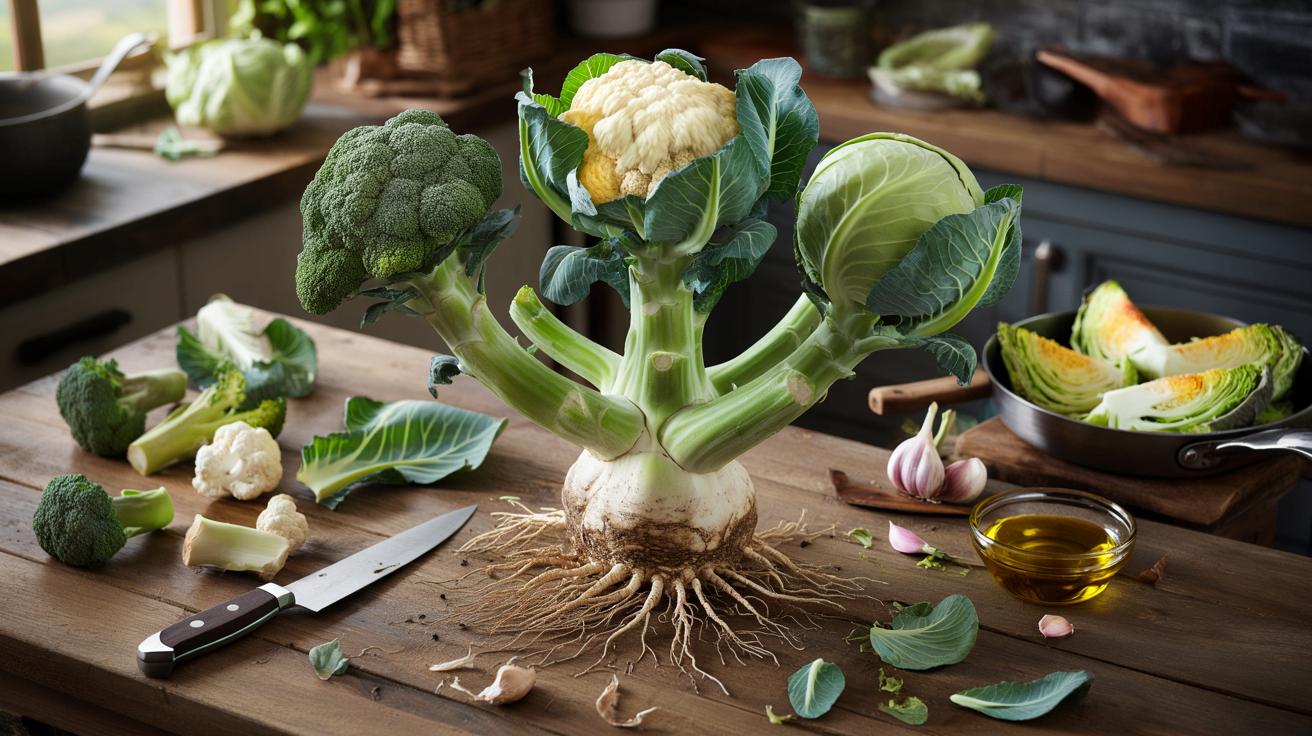
<strong>In the supermarket they sit in different crates, with different prices and very different reputations — yet they share a hidden bond.
We slice cabbage for slaws, steam broccoli when we feel virtuous, and roast cauliflower when we want comfort food. Few shoppers realise that these three vegetables, so separate in our minds and recipes, are simply different expressions of a single coastal plant patiently reshaped by farmers over thousands of years.
The same species wearing three different costumes
On paper the verdict is clear: cabbage, cauliflower and broccoli all belong to one species, Brassica oleracea. In botanical terms, they are not distant relatives. They are siblings.
Their ancestor was a tough wild plant clinging to windy sea cliffs along the Atlantic and Mediterranean coasts. The soil was poor, the air salty, and only a handful of species survived there. Among them, this brassica with thick, fleshy leaves hugging the ground.
Picture a farmer 2,000 years ago walking along a rocky shoreline. Some plants look slightly different: one has bigger leaves, another a swollen stem, another crowded flower buds. Generation after generation, seeds from the “odd” plants are saved and replanted.
No lab, no genetic engineering. Just selection: people choosing, season after season, which plants deserve a future.
- Plants with huge rosettes of leaves gradually gave rise to headed cabbages and savoy types.
- Plants with plump, thickened stems nudged evolution toward kohlrabi.
- Plants with compact flower buds became the foundation for broccoli and cauliflower.
Over centuries, this slow, human-guided process sculpted one wild species into a cast of characters that today fill entire aisles. Genetically, the distance between them is small. What we see as different “vegetables” are closer to different dog breeds: distinct shapes, same species.
Cabbage, cauliflower and broccoli are one plant playing three roles: one emphasises leaves, one flower buds, one the parts in between.
What changes in the kitchen when you see them as one family
This isn’t just a fun trivia line. Understanding the family link can shift how you cook and shop. Once you treat them as variations on one theme, substitutions become easier, recipes feel more flexible, and food waste quietly shrinks.
One basic method, three vegetables
Many cooking techniques work almost identically across the trio. That means you can plan a “base method” and plug in whatever brassica you have lurking in the fridge.
➡️ According to psychology, life really starts to improve when you stop chasing other people’s approval
➡️ Polar bears in Norway’s Arctic are getting fatter and healthier despite the climate crisis
➡️ Psychology confirms it: real inner peace comes when you stop expecting this from others
- High-heat roasting: florets of cauliflower, broccoli heads cut into pieces, and wedges of firm cabbage all roast well at similar times with oil, salt and spices.
- Pan or wok cooking: finely sliced cabbage, broccoli stems and florets, or cauliflower pieces behave in a similar way tossed in a hot pan with garlic and oil.
- Soups and stews: broccoli stems, cauliflower leaves and outer cabbage leaves add body, sweetness and fibre to broths and blended soups.
Instead of fixating on “this is a cauliflower recipe”, it helps to think in terms of structure. Do you need something that stays firm in the oven? Soaks up sauce? Stays slightly crunchy in a stir-fry? Once you answer that, the choice between cabbage, broccoli and cauliflower becomes more about texture than strict rules.
When you grasp the connection, the vegetable drawer stops being a graveyard of leftovers and starts feeling like a toolbox.
Using the parts that usually get binned
These vegetables come from a plant adapted to tough conditions, designed not to waste energy. Mirroring that attitude in the kitchen makes sense, especially with rising food prices.
- Broccoli stems: peel the fibrous outer layer, slice into sticks, and use them in stir-fries, soups or as the base for a creamy purée.
- Cauliflower leaves: toss with oil, salt and spices, then roast until crisp. They turn into savoury, almost nutty chips.
- Leftover cabbage: shred finely and tuck into mixed salads, tacos, dumplings, or quickly sauté with vinegar and spices for a sharp side dish.
Because they share the same species, many trimmings from one can stand in for the “prime” part of another. A handful of cauliflower leaves can bulk out a broccoli pasta. Cabbage strips can stretch a pan of roasted florets.
In the garden: three crops, very similar needs
For anyone growing them, the family resemblance is even more obvious. Plant cabbage, cauliflower and broccoli side by side and they almost behave like clones with different hairstyles.
They like cool weather, sulk in sudden heat, and demand reasonably rich soil. They even attract the same pests.
- Cabbage white butterfly caterpillars, the green “little worms” that riddle the leaves with holes.
- Aphids, clustering on the youngest, tender parts.
- Flea beetles, tiny shiny beetles that leave pinprick holes in new leaves.
If a pest finds one brassica, it will happily move along the row. To it, cabbage, cauliflower and broccoli are identical.
This shared vulnerability can be turned to your advantage. You can plan one protection strategy for all of them: fine mesh covers to block butterflies, similar fertilising schedules, and shared crop rotation plans to keep soil disease in check.
Setting up a “brassica corner” on a balcony
You don’t need a field to see this in action. Even on a small balcony, the same logic holds.
- Use deep containers so the plants can anchor their thick stems.
- Mix compost or well-rotted manure into the potting soil; brassicas are relatively hungry crops.
- During hot spells, shift containers out of the strongest midday sun to prevent stress and bolting.
- Combine early and later varieties to stretch your harvest over several months.
Nutrients: very similar, with useful nuances
The nutritional profile tells a similar story. All three forms of Brassica oleracea pack a comparable mix of vitamins, minerals and plant compounds.
- Solid levels of vitamin C.
- A good amount of fibre, both soluble and insoluble.
- Potassium and a range of other minerals.
- Sulphur-containing compounds typical of cruciferous vegetables, linked to cell-protective functions in current research.
There are differences, but they’re more like shifts in emphasis than dramatic divides. Broccoli tends to bring more vitamin K and some specific antioxidants. Raw cabbage, especially tight, dense heads, can be particularly rich in vitamin C by weight. Cauliflower has a milder flavour that suits people sensitive to the stronger aroma of other brassicas.
Rotating cabbage, cauliflower and broccoli through your meals is a simple way to cover a broad spectrum of very similar, but not identical, nutrients.
What one shape-shifting plant says about our diet
Realising that these “three vegetables” are just one species raises a quiet question about how we think about variety in food. We often imagine a diverse diet as an endless shopping list. In reality, just one botanical group can offer remarkable variation in colour, crunch and flavour.
The same pattern appears elsewhere. Tomatoes range from cherry to beefsteak, all still one species. Wheat becomes bread, pasta or couscous. A handful of highly adaptable plants, honed by centuries of human selection, feeds a large chunk of the planet every day.
At home, this knowledge can make you more resilient. If cauliflower suddenly vanishes from the shelves or shoots up in price, a firm cabbage and a few broccoli stems can perform almost the same job in gratins, soups and tray bakes.
Glossary: a few useful terms
- Brassica oleracea: the scientific name for the species that includes cabbage, cauliflower, broccoli, kale, kohlrabi and several other forms.
- Cultivated variety: a group of plants within a species selected for a particular trait, such as shape, colour or maturity time.
- Selection: the process by which growers choose which plants reproduce, gradually strengthening certain characteristics.
- Crucifers: the wider plant family that includes cabbages, rocket, radishes and mustard, traditionally recognised by four-petalled flowers forming a cross.
One plant, one week: a realistic meal scenario
Imagine opening your fridge on Sunday night. Inside you have one head of cabbage, one cauliflower and one bunch of broccoli. With a bit of planning, that single species can quietly anchor most of your meals for days.
| Day | Meal idea |
|---|---|
| Monday | Roasted tray of cauliflower and broccoli florets with wedges of cabbage, tossed in oil, garlic and smoked paprika. |
| Tuesday | Crunchy raw cabbage salad with grated carrot, toasted seeds and a yoghurt-lemon dressing. |
| Wednesday | Blended soup using broccoli stems and cauliflower leaves, finished with a drizzle of olive oil. |
| Thursday | Stir-fry with shredded cabbage and broccoli florets, soy sauce, ginger and peanuts. |
| Friday | “Rice” made from finely chopped cauliflower, mixed with sliced cabbage and leftover broccoli. |
| Saturday | Oven-baked chips from cabbage and cauliflower leaves as a snack or side. |
From a botanical standpoint you have been eating the same species all week. On the plate, it barely feels that way. Different textures, aromas and cooking methods keep things interesting while your shopping list stays short and your vegetable drawer works harder.
For home cooks and gardeners, that is the quiet power of knowing that cauliflower, broccoli and cabbage are not strangers at all, but three personalities expressed by a single, stubborn coastal plant that learned to thrive — and took us with it.